Overview
The PAR format is introduced by JSR 124, "J2EE Client Provisioning".
Groups of OSGi Bundles may be packaged together in PAR files. The PAR file can be stored in the Software Repository of the RM server. PAR files are processed either by a specific build-in RM plug-in if they contain the appropriate file descriptors or by the default plug-in if they don’t.
A PAR file contains:
One or more OSGi bundles.
Provisioning descriptor named /META-INF/provisioning.xml (see Overview of JSR 124/ PAR Files and the Provisioning Descriptor). The provisioning descriptor contains some general information of the service application - identifier, version, display name, properties, requirements, etc.
TGT descriptor in the META-INF directory. The descriptor points to the exact location of the bundles, part of the application.
RM descriptor in the META-INF directory. It contains information about additional application installation properties - component start up order, lazy start of components, optional of components.
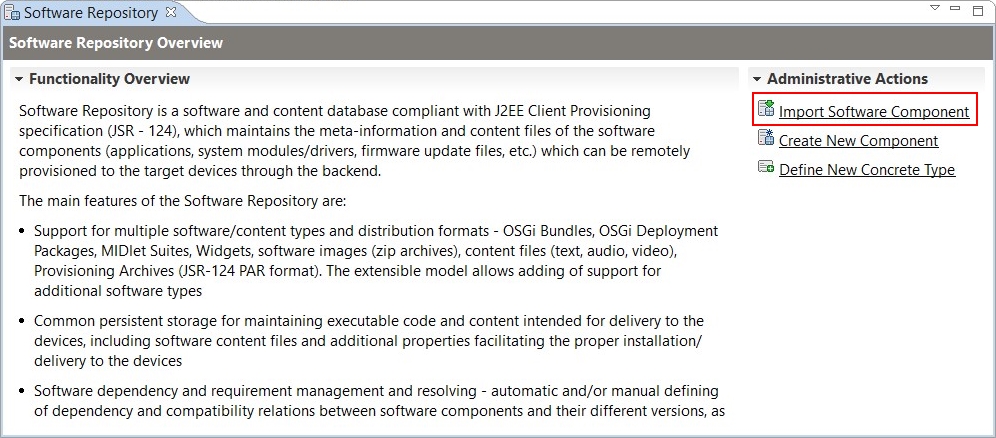
Once an application is packaged as a PAR file it can be imported into RM through the console > Software Repository > Import Software Component.
PAR File Structure
Provisioning XML Schema
Below the schema used in the provisioning descriptor is given:
<?xml version = "1.0" encoding = "UTF-8"?><xsd:schema xmlns= "http://www.w3.org/2001/XMLSchema" targetNamespace= "http://java.sun.com/xml/ns/j2ee-cp" xmlns:j2ee-cp= "http://java.sun.com/xml/ns/j2ee-cp" xmlns:xsd= "http://www.w3.org/2001/XMLSchema" elementFormDefault= "qualified" attributeFormDefault= "unqualified" version= "1.0" ><xsd:annotation><xsd:documentation>This is the XML schema for the J2EE Client Provisioning 1.0 provisioning descriptor.The provisioning descriptor must be named "META-INF/provisioning.xml" in the provisioning archive (PAR).All provisioning descriptors must indicate the provisioning schema by using the reserved namespace http: //java.sun.com/xml/ns/j2ee-cp</xsd:documentation></xsd:annotation><xsd:element name = "provisioning-archive" type= "j2ee-cp:provisioning-archiveType"><xsd:annotation><xsd:documentation>The provisioning-archive element is the root of the provisioning descriptor.</xsd:documentation></xsd:annotation></xsd:element><xsd:complexType name = "provisioning-archiveType"><xsd:sequence><xsd:element ref = "j2ee-cp:tool-descriptions" minOccurs = "0"/><xsd:element ref = "j2ee-cp:client-bundle" maxOccurs = "unbounded"/></xsd:sequence></xsd:complexType><xsd:element name = "tool-descriptions"><xsd:annotation><xsd:documentation>The tool-descriptions element contains information that the developer wishes to expose to stocking tools.When used as a child element of provisioning-archive, it provides information about the entire archive.When used as a child element of client-bundle it provides information specific to a particular bundle.Used in: provisioning-archive, client-bundle</xsd:documentation></xsd:annotation><xsd:complexType><xsd:sequence><xsd:element ref = "j2ee-cp:description" minOccurs = "0" maxOccurs = "unbounded"/><xsd:element ref = "j2ee-cp:display-name" minOccurs = "0" maxOccurs = "unbounded"/><xsd:element ref = "j2ee-cp:icon" minOccurs = "0" maxOccurs = "unbounded"/></xsd:sequence></xsd:complexType></xsd:element><xsd:element name = "client-bundle" type = "j2ee-cp:client-bundleType"><xsd:annotation><xsd:documentation>The client-bundle element contains information about a client bundle that the developer or stockerwishes to communicate to the provisioning server.Used in: provisioning-archive</xsd:documentation></xsd:annotation><xsd:unique name= "catalog-property-name-uniqueness"><xsd:annotation><xsd:documentation>Catalog properties are unique by name per client bundle.</xsd:documentation></xsd:annotation><xsd:selector xpath= "j2ee-cp:catalog-property"/><xsd:field xpath= "j2ee-cp:property-name"/></xsd:unique><xsd:unique name= "requirement-name-uniqueness"><xsd:annotation><xsd:documentation>Device requirements are unique by name per client bundle.</xsd:documentation></xsd:annotation><xsd:selector xpath= "j2ee-cp:device-requirement"/><xsd:field xpath= "j2ee-cp:requirement-name"/></xsd:unique></xsd:element><xsd:complexType name = "client-bundleType"><xsd:sequence><xsd:element ref = "j2ee-cp:content-id"/><xsd:element ref = "j2ee-cp:version" minOccurs = "0"/><xsd:element ref = "j2ee-cp:bundle-type"/><xsd:choice><xsd:element ref = "j2ee-cp:descriptor-file"/><xsd:element ref = "j2ee-cp:content-file"/></xsd:choice><xsd:element ref = "j2ee-cp:tool-descriptions" minOccurs = "0"/><xsd:element ref = "j2ee-cp:user-descriptions" minOccurs = "0"/><xsd:element ref = "j2ee-cp:preview" minOccurs = "0" maxOccurs = "unbounded"/><xsd:element ref = "j2ee-cp:vendor-info" minOccurs = "0"/><xsd:element ref = "j2ee-cp:copyright" minOccurs = "0" maxOccurs = "unbounded"/><xsd:element ref = "j2ee-cp:device-requirement" minOccurs = "0" maxOccurs = "unbounded"/><xsd:element ref = "j2ee-cp:catalog-property" minOccurs = "0" maxOccurs = "unbounded"/></xsd:sequence></xsd:complexType><xsd:element name = "content-id" type = "xsd:string"><xsd:annotation><xsd:documentation>Each client-bundle has a logical identifier for the content that it represents. There can be different versions of the content as it is maintained or enhanced over time.Also there can be different variants of the content targetted at different locales or at different classes of client device.In all these cases, the versions and variants would be different bundles all of which have the same content-id.The content-id should be chosen by the developer in such a way that it is highly unlikely to clash with any other content's content-id.One good way to do this is to use a URL that might point to information about the content on the developer's web site.Used in: provisioning-archive</xsd:documentation></xsd:annotation></xsd:element><xsd:element name = "version" type = "xsd:string"><xsd:annotation><xsd:documentation>The version element contains a string indicating the version of the content which is represented by this bundle, e.g. 1.1.2.If the version element is missing, or the version element does not contain a version string, the bundle has no version and must be treated by the provisioning framework as having a lower version than bundles with the same app ID, but that do have a version.Used in: provisioning-archive</xsd:documentation></xsd:annotation></xsd:element><xsd:element name = "descriptor-file"><xsd:annotation><xsd:documentation>The descriptor-file element. The text contents of this element should be a URI for the descriptor file.The URI may be absolute (that is, it may have a scheme such as "http://" ), indicating that the descriptor file is not inside the PAR file. Otherwise, it is interpreted relative to the PAR file root.Used in: client-bundle</xsd:documentation></xsd:annotation><xsd:complexType><xsd:simpleContent><xsd:extension base = "xsd:string"><xsd:attribute name = "mime-type" type = "xsd:string"/></xsd:extension></xsd:simpleContent></xsd:complexType></xsd:element><xsd:element name = "bundle-type"><xsd:annotation><xsd:documentation>The bundle-type element contains a string that categorizes the type of content held in the bundle.Used in: client-bundle</xsd:documentation></xsd:annotation><xsd:simpleType><xsd:restriction base = "xsd:string"><xsd:enumeration value = "RINGTONE"/><xsd:enumeration value = "SCREENSAVER"/><xsd:enumeration value = "WALLPAPER"/><xsd:enumeration value = "TEXT_MESSAGE"/><xsd:enumeration value = "MEDIA_MESSAGE"/><xsd:enumeration value = "LOGO"/><xsd:enumeration value = "AUDIO"/><xsd:enumeration value = "VIDEO"/><xsd:enumeration value = "MARKUP"/><xsd:enumeration value = "TEXT"/><xsd:enumeration value = "IMAGE"/><xsd:enumeration value = "ICON"/><xsd:enumeration value = "ANIMATION"/><xsd:enumeration value = "UNCLASSIFIED"/><xsd:enumeration value = "APPLICATION"/><xsd:enumeration value = "SPEECH"/><xsd:enumeration value = "SKIN"/><xsd:enumeration value = "V_CARD"/><xsd:enumeration value = "V_CALENDAR"/><xsd:enumeration value = "BOOKMARK"/><xsd:enumeration value = "LIBRARY"/><whiteSpace value = "collapse"/></xsd:restriction></xsd:simpleType></xsd:element><xsd:element name = "content-file"><xsd:annotation><xsd:documentation>The content-file element. The text contents of this element should be a URI for the content file.The URI may be absolute (that is, it may have a scheme such as "http://" ), indicating that the content file is not inside the PAR file. Otherwise, it is interpreted relative to the PAR file root.Used in: client-bundle</xsd:documentation></xsd:annotation><xsd:complexType><xsd:simpleContent><xsd:extension base = "xsd:string"><xsd:attribute name = "mime-type" type = "xsd:string"/></xsd:extension></xsd:simpleContent></xsd:complexType></xsd:element><xsd:element name = "user-descriptions"><xsd:annotation><xsd:documentation>The user-descriptions element contains information about the client bundle supplied by the bundle developer that can be shown by the provisioning server to the user of the client bundle.The description, display names and icons indicate their localisation properties.Used in: client-bundle</xsd:documentation></xsd:annotation><xsd:complexType><xsd:sequence><xsd:element ref = "j2ee-cp:display-name" minOccurs = "0" maxOccurs = "unbounded"/><xsd:element ref = "j2ee-cp:description" minOccurs = "0" maxOccurs = "unbounded"/><xsd:element ref = "j2ee-cp:icon" minOccurs = "0" maxOccurs = "unbounded"/></xsd:sequence></xsd:complexType></xsd:element><xsd:element name = "description"><xsd:annotation><xsd:documentation>The description element contains a human readable string. The locale attribute indicates the locale of the description.Used in: tool-descriptions, user-descriptions</xsd:documentation></xsd:annotation><xsd:complexType><xsd:simpleContent><xsd:extension base = "xsd:string"><xsd:attribute name = "locale" type = "xsd:string"/></xsd:extension></xsd:simpleContent></xsd:complexType></xsd:element><xsd:element name = "display-name"><xsd:annotation><xsd:documentation>The display-name element contains a string that can be used to name a component in a tool. The locale attribute indicates the locale of the name.Used in: tool-descriptions, user-descriptions</xsd:documentation></xsd:annotation><xsd:complexType><xsd:simpleContent><xsd:extension base = "xsd:string"><xsd:attribute name = "locale" type = "xsd:string"/></xsd:extension></xsd:simpleContent></xsd:complexType></xsd:element><xsd:element name = "icon"><xsd:annotation><xsd:documentation>The icon element contains a relative URI to an icon in the same archive.The locale attribute indicates the locale of the description.Used in: tool-descriptions, user-descriptions</xsd:documentation></xsd:annotation><xsd:complexType><xsd:simpleContent><xsd:extension base = "xsd:string"><xsd:attribute name = "locale" type = "xsd:string"/><xsd:attribute name = "mime-type" type = "xsd:string"/></xsd:extension></xsd:simpleContent></xsd:complexType></xsd:element><xsd:element name = "device-requirement"><xsd:annotation><xsd:documentation>The device-requirement elements contain all the dependencies that the client bundle has on the capabilities of client devices.Used in: client-bundle</xsd:documentation></xsd:annotation><xsd:complexType><xsd:sequence><xsd:element ref = "j2ee-cp:requirement-name"/><xsd:element ref = "j2ee-cp:requirement-value"/></xsd:sequence></xsd:complexType></xsd:element><xsd:element name = "requirement-name" type = "xsd:string"><xsd:annotation><xsd:documentation>The name of the device requirement.</xsd:documentation></xsd:annotation></xsd:element><xsd:element name = "requirement-value" type = "xsd:string"><xsd:annotation><xsd:documentation>The value of the device requirement.</xsd:documentation></xsd:annotation></xsd:element><xsd:element name = "vendor-info"><xsd:annotation><xsd:documentation>The vendor info element contains information about the vendor of the client bundle.Used in: client-bundle</xsd:documentation></xsd:annotation><xsd:complexType><xsd:sequence><xsd:element ref = "j2ee-cp:vendor-name"/><xsd:element ref = "j2ee-cp:vendor-url" minOccurs = "0"/><xsd:element ref = "j2ee-cp:vendor-description" minOccurs = "0"/></xsd:sequence></xsd:complexType></xsd:element><xsd:element name = "vendor-name"><xsd:annotation><xsd:documentation>The name of the bundle's vendor.Used in: vendor-info</xsd:documentation></xsd:annotation><xsd:complexType><xsd:simpleContent><xsd:extension base = "xsd:string"><xsd:attribute name = "locale" type = "xsd:string"/></xsd:extension></xsd:simpleContent></xsd:complexType></xsd:element><xsd:element name = "vendor-description"><xsd:annotation><xsd:documentation>The vendor-description gives a textual description of the vendor of this bundle.Used in: vendor-info</xsd:documentation></xsd:annotation><xsd:complexType><xsd:simpleContent><xsd:extension base = "xsd:string"><xsd:attribute name = "locale" type = "xsd:string"/></xsd:extension></xsd:simpleContent></xsd:complexType></xsd:element><xsd:element name = "vendor-url"><xsd:annotation><xsd:documentation>The vendor-url gives an external URL to a web site. This URL should be suitable for giving a user more information about the vendor.Used in: vendor-info</xsd:documentation></xsd:annotation><xsd:complexType><xsd:simpleContent><xsd:extension base = "xsd:string"><xsd:attribute name = "locale" type = "xsd:string"/></xsd:extension></xsd:simpleContent></xsd:complexType></xsd:element><xsd:element name = "catalog-property"><xsd:annotation><xsd:documentation>The portal may define various catalog properties it uses to organize bundles.For example, it could use catalog properties to assign bundles into categories understandable to users, or it could use them to indicate the billing model to be used for each bundle.Catalog properties are unique by name. It is an error to have two catalog properties of the same name in a bundle.Used in: client-bundle</xsd:documentation></xsd:annotation><xsd:complexType><xsd:sequence><xsd:element ref = "j2ee-cp:property-name"/><xsd:element ref = "j2ee-cp:property-value"/></xsd:sequence></xsd:complexType></xsd:element><xsd:element name = "property-name" type = "xsd:string"><xsd:annotation><xsd:documentation>The name of the property.Used in: catalog-property </xsd:documentation></xsd:annotation></xsd:element><xsd:element name = "property-value" type = "xsd:string"><xsd:annotation><xsd:documentation>The value of the property.Used in: catalog-property.</xsd:documentation></xsd:annotation></xsd:element><xsd:element name = "copyright"><xsd:annotation><xsd:documentation>A copyright element contains a copyright notice for this bundle that may be shown to the user.If a uri attribute is present this indicates an archive entry name of the copyright notice as a text file.The presence of the uri attribute loads the notice from that entry in preference to the text node.The locale attribute indicates the locale of the copyright notice.</xsd:documentation></xsd:annotation><xsd:complexType><xsd:simpleContent><xsd:extension base = "xsd:string"><xsd:attribute name = "uri" type = "xsd:string"/><xsd:attribute name = "locale" type = "xsd:string"/></xsd:extension></xsd:simpleContent></xsd:complexType></xsd:element><xsd:element name = "preview"><xsd:annotation><xsd:documentation>The preview element contains the URI of some content file that can be displayed to the user as a preview of the bundle.Used in: client-bundle</xsd:documentation></xsd:annotation><xsd:complexType><xsd:simpleContent><xsd:extension base = "xsd:string"><xsd:attribute name = "locale" type = "xsd:string"/><xsd:attribute name = "mime-type" type = "xsd:string"/></xsd:extension></xsd:simpleContent></xsd:complexType></xsd:element></xsd:schema>Provisioning xml-example<?xml version="1.0"?><provisioning-archive xmlns="http://java.sun.com/xml/ns/j2ee-cp" xmlns:xsi="http://www.w3.org/2001/XMLSchema-instance" xsi:schemaLocation="http://java.sun.com/xml/ns/j2ee-cp Provisioning_1_0.xsd"><client-bundle><content-id>example</content-id><version>1.0</version><bundle-type>APPLICATION</bundle-type><descriptor-file mime-type="application/x-tgt-descriptor">/META-INF/example.tgt</descriptor-file><user-descriptions><display-name>example application</display-name><icon mime-type="image/png">/META-INF/example.png</icon></user-descriptions><vendor-info><vendor-name>Bosch</vendor-name><vendor-url>http://www.bosch.com/</vendor-url><vendor-description>Bosch Digital</vendor-description></vendor-info></client-bundle><client-bundle><content-id>example</content-id><version>1.0</version><bundle-type>APPLICATION</bundle-type><descriptor-file mime-type="mprm/service-descriptor">/META-INF/example.mprm</descriptor-file></client-bundle></provisioning-archive>TGT Descriptor Schema
Below the schema used in the TGT descriptor is given.
<?xml version = "1.0" encoding = "UTF-8"?><xsd:schema xmlns= "http://www.w3.org/2001/XMLSchema" xmlns:xsd= "http://www.w3.org/2001/XMLSchema" ><xsd:annotation><xsd:documentation>This is the XML schema for the TGT descriptor.TGT descriptor points to exact location of bundles being part from an application.The TGT descriptor should be described with 'descriptor-file' sub tag of 'client bundle' tag in "META-INF/provisioning.xml" in the provisioning archive (PAR).Mime type of 'descriptor-file' tag should be set to "application/x-tgt-descriptor".Value of 'descriptor-file' should points where TGT file is placed in PAR archive.</xsd:documentation></xsd:annotation><xsd:element name = "bundle-tgt-descriptor" type= "bundle-tgt-descriptorType"><xsd:annotation><xsd:documentation>The bundle-tgt-descriptor element is the root of the tgt descriptor.'Name' and 'version' attributes are bound to the application which bundles this TGT file describes.</xsd:documentation></xsd:annotation></xsd:element><xsd:complexType name = "bundle-tgt-descriptorType"><xsd:sequence><xsd:element ref = "resource" maxOccurs = "unbounded"/></xsd:sequence><xs:attribute name= "name" type= "xs:string" /><xs:attribute name= "version" type= "xs:string" /></xsd:complexType><xsd:element name = "resource"><xsd:annotation><xsd:documentation>The resource element contains information about jar files of OSGI bundles included into current application.'href' attribute points the relative path to the PAR file root of the jar file.'mime-type' should be set to "application/x-osgi-bundle".</xsd:documentation></xsd:annotation><xs:complexType><xs:complexContent><xs:restriction base= "xs:string"><xs:attribute name= "href" type= "xs:string"/><xs:attribute name= "mime-type" type= "xs:string" /></xs:restriction></xs:complexContent></xs:complexType></xsd:element></xsd:schema>TGP descriptor-example
<?xml version="1.0" encoding="UTF-8"?><bundle-tgt-descriptor name="example" version="1.0"> <resource href="res/example1.jar" mime-type="application/x-osgi-bundle"/> <resource href="res/example2.jar" mime-type="application/x-osgi-bundle"/></bundle-tgt-descriptor>RM Descriptor Schema
Below the schema used in the RM descriptor is given.
<?xml version = "1.0" encoding = "UTF-8"?> <xsd:schema xmlns= "http://www.w3.org/2001/XMLSchema" xmlns:xsd= "http://www.w3.org/2001/XMLSchema" > <xsd:annotation> <xsd:documentation> This is the XML schema for the mprm descriptor. it contains information about additional properties taking effect on application installation - component start up order, lazy start of components, optional of components.The mprm descriptor should be described with 'descriptor-file' sub tag of 'client bundle' tag in "META-INF/provisioning.xml" in the provisioning archive (PAR).Mime type of 'descriptor-file' tag should be set to "mprm/service-descriptor".Value of 'descriptor-file' should points where mprm descriptor file is placed in PAR archive.</xsd:documentation></xsd:annotation><xsd:element name = "service-mprm-descriptor"> <xsd:annotation> <xsd:documentation>The service-mprm-descriptor element is the root of the mprm descriptor. </xsd:documentation></xsd:annotation> </xsd:element><xsd:complexType name = "service-mprm-descriptorType"><xsd:sequence> <xsd:element ref = "provider" minOccurs = "0"/> <xsd:element ref = "variant" maxOccurs = "1"/> </xsd:sequence></xsd:complexType><xsd:element name = "provider" type = "xsd:string"> <xsd:annotation> <xsd:documentation> The provider element contains the application vendor. </xsd:documentation> </xsd:annotation> </xsd:element><xsd:element name = "variant" type = "variantType"> <xsd:annotation> <xsd:documentation>The variant element contains information about different OSGi bundles includes in application. </xsd:documentation> </xsd:annotation></xsd:element><xsd:complexType name = "variantType"><xsd:sequence><xsd:element ref = "id"/> <xsd:element ref = "name" minOccurs = "0"/> <xsd:element ref = "bundles"/> </xsd:sequence> </xsd:complexType> <xsd:element name = "id" type = "xsd:string"> <xsd:annotation> <xsd:documentation> Contains the path of TGT file this mprm descriptor is bound to. E.g.: META-INF/example.tgt</xsd:documentation> </xsd:annotation> </xsd:element><xsd:element name = "name" type = "xsd:string"> <xsd:annotation> <xsd:documentation> Contains application content id.</xsd:documentation> </xsd:annotation> </xsd:element><xsd:element name = "version" type = "xsd:string"><xsd:annotation><xsd:documentation>The version element contains a string indicating the version of the content which is represented by this bundle, e.g. 1.1.2. If the version element is missing, or the version element does not contain a version string, the bundle has no version and must be treated by the provisioning framework as having a lower version than bundles with the same app ID, but that do have a version. Used in: service-mprm-descriptor </xsd:documentation> </xsd:annotation> </xsd:element> <xsd:element name = "bundles"> <xsd:annotation> <xsd:documentation> Describes application components.</xsd:documentation> </xsd:annotation> <xsd:complexType> <xsd:sequence> <xsd:element ref = "bundle" minOccurs = "0" maxOccurs = "unbounded"/> <xsd:element ref = "bundle-ref" minOccurs = "0" maxOccurs = "unbounded"/> </xsd:sequence> </xsd:complexType> </xsd:element> <xsd:element name = "bundle"> <xsd:annotation> <xsd:documentation> Contains extra properties of OSGi bundles included into application.</xsd:documentation> </xsd:annotation> <xsd:complexType> <xsd:sequence> <xsd:element ref = "name" maxOccurs = "1"/> <xsd:element ref = "vendor" minOccurs = "0"/> <xsd:element ref = "order" minOccurs = "0"/> <xsd:element ref = "start-level" minOccurs = "0"/> <xsd:element ref = "optional" minOccurs = "0"/> <xsd:element ref = "lazy-start" minOccurs = "0"/> </xsd:sequence> </xsd:complexType> </xsd:element><xsd:element name = "bundle-ref"> <xsd:annotation> <xsd:documentation> Describes application component which is not included into current PAR. But the componentshould already exist in RM Software Repository. E.g. this component may be an OSGi bundleor another bundle group of OSGi bundles.</xsd:documentation> </xsd:annotation> <xsd:complexType> <xsd:sequence> <xsd:element ref = "content-id" maxOccurs = "1"/> <xsd:element ref = "global-id" minOccurs = "0"/> <xsd:element ref = "version" minOccurs = "0"/><xsd:element ref = "type" minOccurs = "0"/><xsd:element ref = "order" minOccurs = "0"/> <xsd:element ref = "start-level" minOccurs = "0"/> <xsd:element ref = "optional" minOccurs = "0"/> <xsd:element ref = "lazy-start" minOccurs = "0"/> </xsd:sequence> </xsd:complexType> </xsd:element><xsd:element name = "name" type = "xsd:string"> <xsd:annotation> <xsd:documentation> Symbolic name of the OSGi bundle.</xsd:documentation> </xsd:annotation> </xsd:element> <xsd:element name = "vendor" type = "xsd:string"> <xsd:annotation> <xsd:documentation> Vendor of the OSGi bundle.</xsd:documentation> </xsd:annotation> </xsd:element> <xsd:element name = "order" type = "xsd:string"> <xsd:annotation> <xsd:documentation> Startup order of the OSGi bundle. Used when bundle is installed on end-user device.</xsd:documentation> </xsd:annotation> </xsd:element><xsd:element name = "optional" type = "xsd:string"> <xsd:annotation> <xsd:documentation> Indicates whether the OSGi bundle is optional or not.</xsd:documentation> </xsd:annotation> </xsd:element><xsd:element name = "lazy-start" type = "xsd:string"> <xsd:annotation> <xsd:documentation> Indicates whether the OSGi bundle should be started lazy.</xsd:documentation> </xsd:annotation> </xsd:element><xsd:element name = "content-id" type = "xsd:string"> <xsd:annotation> <xsd:documentation> Content id of existing Software Repository client bundle, which will be added as application component.</xsd:documentation> </xsd:annotation> </xsd:element><xsd:element name = "global-id" type = "xsd:string"> <xsd:annotation> <xsd:documentation> Global id of existing Software Repository client bundle, which will be added as application component.</xsd:documentation> </xsd:annotation> </xsd:element><xsd:element name = "type" type = "xsd:string"> <xsd:annotation> <xsd:documentation> Concrete type id of existing Software Repository client bundle, which will be added as application component.E.g. OSGi Bundle, Bundle Group.</xsd:documentation> </xsd:annotation> </xsd:element><xsd:element name = "version" type = "xsd:string"> <xsd:annotation> <xsd:documentation> Version of existing Software Repository client bundle, which will be added as application component.</xsd:documentation> </xsd:annotation> </xsd:element></xsd:schema>RM descriptor-example
<?xml version="1.0" encoding="UTF-8"?><service-mprm-descriptor> <provider>Bosch Digital</provider> <variant> <id>META-INF/example.tgt</id> <name>example/name> <bundles> <bundle> <name>example1_symbolic_name</name> <vendor>Bosch Digital</vendor> <order>0</order> </bundle> <bundle> <name>example2_symbolic_name</name> <vendor>Bosch Digital</vendor> <order>1</order> </bundle> <bundle-ref> <content-Id>internal group</content-Id> <global-Id>internal group</global-Id> <type>Bundle Group</type> </bundle-ref> </bundles> </variant></service-mprm-descriptor>